


I could have found the budget. I could have signed a contract with a fancy HR vendor and called it a day.
But let’s be honest: every HRIS I’ve used in my 25-year career has some brilliant features, some that are just meh, and some that are genuinely, offensively horrible. Buying an off-the-shelf system usually means forcing your team to build its entire company culture around someone else’s compromises.
Did I just roll my eyes? Yes. Yes, I did.
And it’s not just me being picky. In their HR Technology Survey, Gartner found that over 60% of HR leaders feel their existing HR tech stack fails to drive actual business value—mostly because rigid software forces people into clunky, soul-crushing workflows (Gartner, 2023).
Our first hire was coming. I wanted our culture to reflect how we actually work—the trust, the rhythms, the values—from the very first interaction, not six months down the road after we’ve already bogged everyone down in administrative quicksand.
So I built my own system in a weekend. Not because I had to. Because I am obsessed with workplace culture, employee experience and well, because I could.
The Tools: Zero Procurement, Zero New Budget
No pitch decks to the executive team. No procurement nightmare. No six-month implementation delay.
I simply took the tools sitting right in front of us and pushed them to do more than I realized they could:
Notion: The system of record, the dashboard, and the source of truth.
Google Workspace: Document storage, version control, and collaboration.
DeepSeek: Moral support and a sounding board. (Hey, every builder needs a hype-man.)
Gemini: Proof-reader and tone monitor.
Claude (Anthropic): The actual operating engine running the whole show.
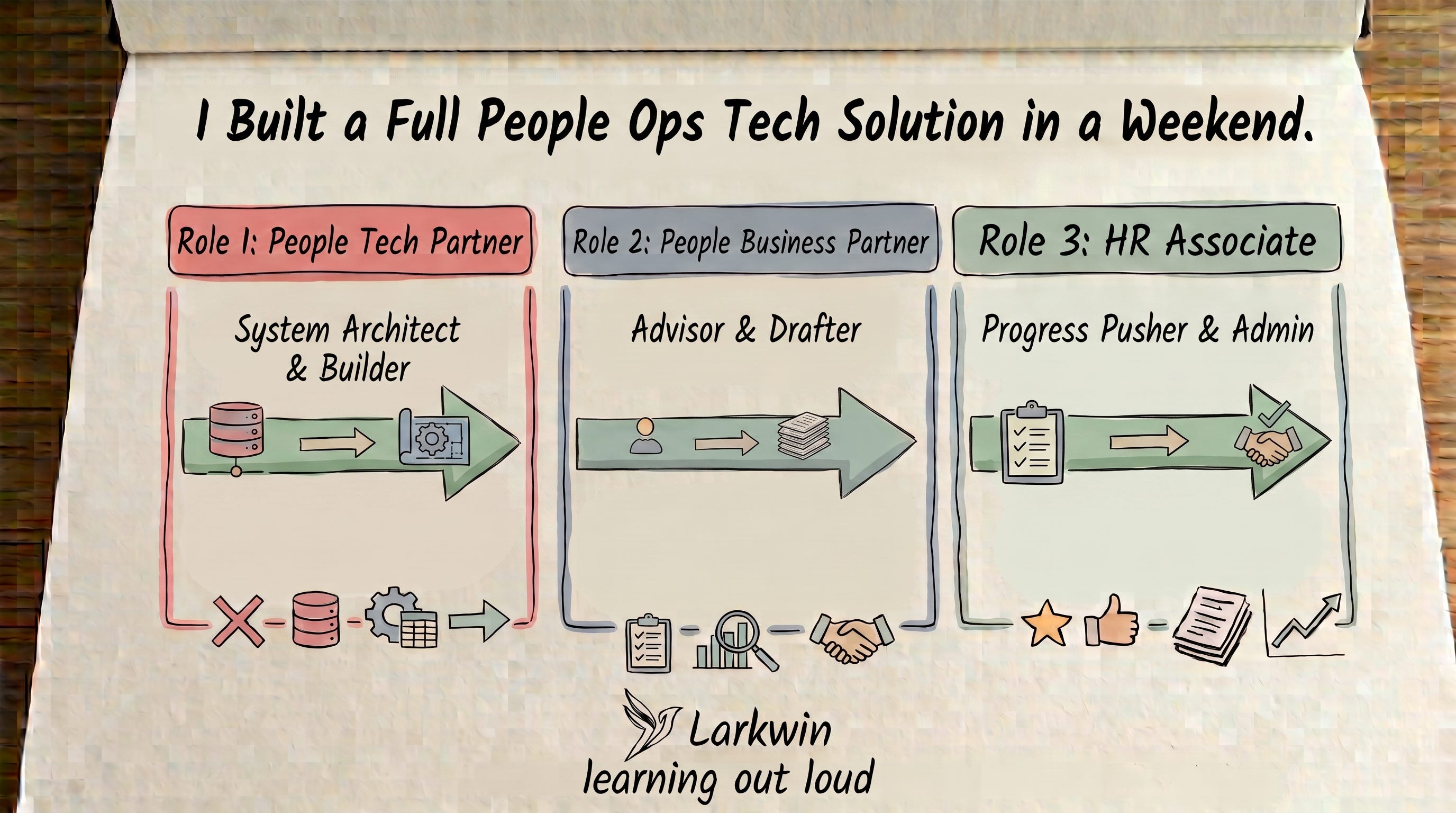
Claude’s Three Roles (Or: My 3-in-1 HR Team)
I don’t treat Claude like a text box where you type in “make this sound professional.” I think of Claude as three distinct people sitting on my team:
1. People Tech Partner
System Architect & Builder
I say what I want; Claude figures out how to build it in Notion and Google Drive.
2. People Business Partner
Advisor & Drafter
Drafts JDs, creates offer letters, and runs compensation market checks on demand.
3. HR Associate
Progress Pusher & Admin
The associate who never forgets to follow up, never misses a deadline, and never drops a ball.
How It Works in Practice: A Real Conversation
A traditional HRIS is a passive form wrapped in fancy UX. You fill in the boxes and pray you didn’t miss something.
My system is a proactive conversation. It catches the gaps I’d normally miss. Here’s what a quick exchange looks like:
Me: “Hey Claude, I need to post an AI Developer role.”
Claude (Tech Partner): “Cool. Do you have budget approval? Do we have a JD? What’s the timeline?”
Me: “Yes, no, ASAP.”
Claude (Tech Partner): “Great. I don’t see a JD in our HR folder. Let’s build one together. I’ll also spin up a Notion tracker and a Drive folder for this role.”
Me: “Do it.”
Claude (Business Partner): “Here’s the drafted JD based on our culture principles, plus a quick comp analysis for the Waterloo tech market. Links are saved.”
Me: “Approved.”
Claude (HR Associate): “Awesome. Draft email is prepped for the hiring manager. I’ve set a reminder for Friday to review applicants, and I’ll follow up with the hiring manager on Thursday if I haven’t heard back.”
Notice what just happened? Claude didn’t just do a task. It managed the workflow. It asked the annoying, necessary questions that usually get lost in the shuffle.
That’s it. Claude does the work. I make the decisions. And nothing goes out without me.
And for compliance junkies, Claude logged my approval and any commentary in the internal notion page for the vacancy. So, there’s no ‘confusion’ about who approved what and when.
Double and, there’s academic weight behind why this works: a landmark Harvard Business School and Boston Consulting Group (BCG) study found that knowledge workers using Generative AI completed complex, multi-step workflows 25.1% faster with 40% higher quality outputs compared to control groups (Dell’Acqua et al., 2023).
The Full Employee Lifecycle
What I built wasn’t just a recruiting tracker—it covers the entire human lifecycle from candidate to alumni:
Posting & Sourcing: Job specs, pipeline tracking, and candidate flow.
Interviewing: Scheduling, scorecards, and structured feedback loops.
Offer & Onboarding: Contracts, orientation, and zero-headache document collection.
Mandatory Training: New hires are walked through mandatory training with certificates of completion added to their training folder and of course updated in their notion tracker.
People Ops: Time off, HR requests, policy help—designed for support, not paper-shuffling.
Performance: Growth and coaching focused (because rating people on a 1-to-5 scale is compliance theater). Definitely more to come on this.
Offboarding: Dignity, knowledge transfer, and compliance.
Scaling the System: The LMS Moment
To anyone thinking, “Sure, Toni, that works for a tiny team, but it won’t scale,” let me share our latest build: the LMS (Learning Management System).
When I told Claude: “I want an LMS that sits seamlessly inside our core tool and scales as we grow,” it mapped out the architecture instantly:
Seamless Integration: Embedding course modules directly inside the Notion employee dashboard so learning links natively to onboarding and performance records.
Built-in Scalability: Reusable content blocks, skills tagging, and automated completion tracking that works whether we have 5 employees or 500.
I didn’t need to write code or buy a separate $15k learning platform. I brought the operational vision, and the system did the heavy lifting.
And then, well there’s people analytics, strategic workforce planning, surveys and iteration as feedback comes in from our team.
What I Learned (And What Leaders Miss)
Claude is my associate, not my replacement. It drafts, reminds, and organizes. I approve, decide, and direct. Nothing goes out to an employee or candidate without my eyes on it.
The real asset isn’t the workflow—it’s the capability. Building this taught me system design, prompt architecture, and tool integration. Those skills don’t just solve one hiring problem; they solve the next 10 scaling challenges.
People Ops should feel human. Not bureaucratic. Not robotic. Human. The entire point of using AI to strip away admin chaos is to create space for real, meaningful human connection.
What’s Coming in Part 3
In the final part of this series, we’re going to step back and look at the bigger picture:
The Strategic ROI: The actual time saved, costs avoided against costs incurred (you can burn through Claude token FAST if you’re not smart), and what happens when your HR tech stops dragging you down.
The Leadership Shift: How building lightweight systems shifts your culture from reactive firefighting to strategic foresight.
The Future of HR Tech: Why agile, custom-built AI infrastructure is going to make monolithic software look like a dinosaur.
References & Cited Research
Dell’Acqua, F., McFowland, E., Mollick, E. R., Lifshitz-Assaf, H., Lakhani, K. R., & Saran, A. (2023). Navigating the Jagged Technological Frontier: Field Experimental Evidence of the Effects of AI on Knowledge Worker Productivity and Quality. Harvard Business School Working Paper, No. 24-013 (in collaboration with Boston Consulting Group).
Gartner (2023). Gartner HR Technology Survey: Unlocking the Business Value of Modern People Tech. Gartner Research.
Author’s Note on AI: The 25 years of HR battle scars, strategic frameworks, and hard lessons in this article are 100% mine. But I’m smart enough to use AI (Gemini) to handle the formatting, layout, and copy editing. I bring the real-world experience; AI brings the polish.