


After 25 years in HR—leading people ops through bank mergers, hospital integrations, and a global pandemic—I’ve come to a conclusion that might sound like heresy:
Most organizations have no idea what talent management actually is.
We use the term constantly. We build “Talent Management” departments and roll out “Talent” strategies. We treat talent like inventory to be tracked, managed, and optimized. But somewhere along the line, HR forgot the people piece of talent management.
Here’s what I mean.
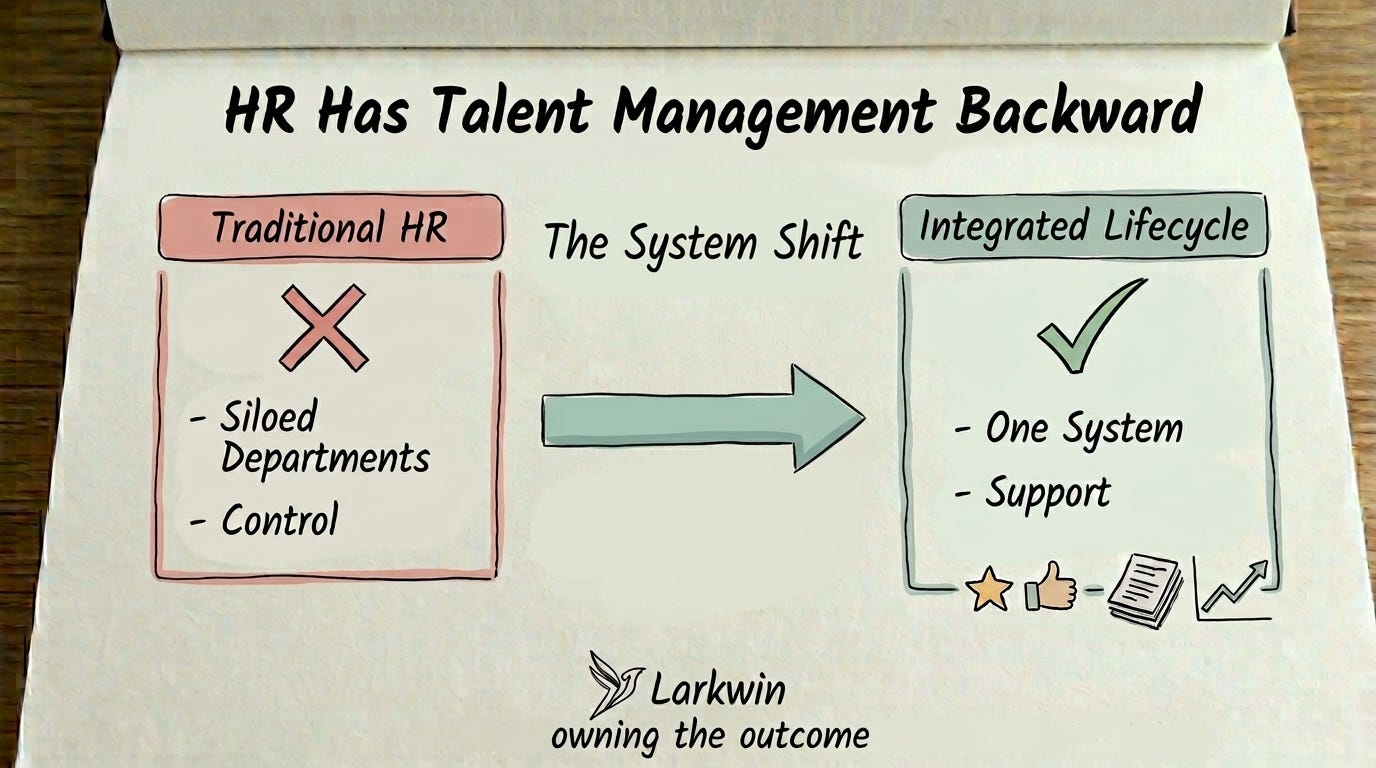
The Conventional View: A Siloed Mess
In most organizations, “Talent Management” is treated as a niche subset of HR. It usually covers:
Recruiting & selection
Performance management
Succession planning
Leadership development
Employee engagement
Everything else—payroll, benefits, time off, employee relations, compliance—gets dumped into “People Operations” or “HR Admin”.
To make matters worse, Talent Management often gets tucked away inside Learning & Development (L&OD). It sounds logical on paper, until you realize it creates four separate islands that barely talk to each other:
Talent Acquisition: Focused on filling roles fast.
Talent Management (L&OD): Focused on long-term development and succession.
Employee Relations: Focused on risk, policy, and liability.
People Operations: Buried under paperwork and admin.
Each team has its own metrics, its own software, its own budget, and its own idea of what “success” looks like. They are all working on the exact same employees, but they aren’t working together.
We’ve built walls where there should be bridges.
The Problem: Friction by Design
When you separate “talent management” from daily people operations, you create a system that is fragmented at best and hypocritical at worst.
Consider these common corporate contradictions:
You invest heavily in recruiting top talent, then make it painful for them to take time off.
You design high-potential leadership programs, then bog managers down in five layers of administrative approval.
You preach growth and psychological safety, then enforce a performance review system built for control, not coaching.
You claim to build a culture of trust, then make employees jump through hoops for basic HR requests.
Every single operational decision either reinforces or undermines your talent strategy. There is no separation. There never was.
What Talent Management Actually Is
Talent management isn’t a department. It isn’t a quarterly initiative, and it isn’t a perk saved for “high-potentials”.
Talent management is the entire employee experience—from the moment someone reads your job ad to the moment they walk out the door for the last time.
It’s how you:
Post a job: Does it sound human, or read like a legal disclaimer?
Interview: Do candidates feel respected, or processed?
Make an offer: Is it transparent, or a game of chicken?
Onboard: Do they feel welcomed, or overwhelmed with forms?
Handle time off: Does it feel like a support system, or a micromanaged policy?
Evaluate performance: Is it focused on growth, or compliance?
Offboard: Is it handled with dignity, or as a risk to be contained?
If you think Talent Management is...
If you think Talent Management is... ➔ Try seeing it as:
A standalone department ➔ The entire operating system
Reserved for “high potentials” ➔ Designed for every single employee
Separate from daily operations ➔ Fully integrated into every workflow
A collection of HR programs ➔ A sequence of human experiences
Something you implement ➔ Something you intentionally design
The Weekend Experiment
Recently, our company prepped for its first official hire.
I could have bought an off-the-shelf HRIS. I’ve used dozens over my 25-year career, and almost all of them suffer from the same structural flaw: they treat talent management as a separate, add-on module.
Instead, I decided to run an experiment. I took a single weekend and built our entire People Operations system from scratch using the modern tools we already had available.
I didn’t build a recruiting tool. I didn’t build a performance tool.
I built a single, unified environment that spans the entire employee lifecycle—where culture, performance, admin, and development live in the exact same place.
Because here is the truth: You’re already doing talent management. Every time you approve time off, respond to an inquiry, or run a 1-on-1, you are shaping talent.
The only question is whether you’re doing it intentionally.
What’s Next in This Series
Over the next two articles, I’m pulling back the curtain on the technical and operational side of this build:
Part 2: How I Built a Custom HRIS in 48 Hours — The architecture, the tools I used, and how I tied recruiting, onboarding, and performance into one seamless flow without enterprise software bloat.
Part 3: The Blueprint & The Results — The exact templates, workflows, and lessons learned from running an intentional, lightweight People Ops engine in the real world.
Enjoyed this article? Hit the Subscribe button below so you don’t miss Part 2 when it drops next week. I’d also love to hear your thoughts in the comments: How siloed is HR in your current organization?
Author's Note on AI: The 25 years of HR battle scars, strategic frameworks, and hard lessons in this article are 100% mine. But I'm smart enough to use AI (Gemini) to handle the formatting, layout, and copy editing. I bring the real-world experience; AI brings the polish.